
Key Takeaways
Dementia is not an isolated brain disease
It is the brain’s manifestation of the same biological breakdown that drives most chronic disease.
3 systems break down:
Energy • Growth • Repair
What to focus on:
The 7 Core Habits—adapted for brain health
What if we’ve been looking at dementia entirely wrong?
We’ve long treated it as a mysterious, isolated brain disease. But science is revealing a more hopeful reality: your mind doesn’t exist in a vacuum. It is an organ—the most energy-hungry one in your body—and it thrives or fails based on the physical systems supporting it.
When we stop viewing the brain in isolation, we see that dementia is often just the brain’s manifestation of the same “biological brokenness” that drives almost every other chronic disease. For decades, we categorized Alzheimer’s, Parkinson’s, and vascular dementia as distinct conditions. We now know “pure” versions are rare; they are points on a broad spectrum of neurodegeneration fueled by the same root causes: inflammation, mitochondrial dysfunction, and insulin resistance.
Think of chronic inflammation as a fire. In your gut, it’s IBS; in your joints, it’s arthritis; on your skin, a rash. In your brain? That same fire looks like memory loss. The symptoms change depending on the organ taking the hit, but the fire is the same.
Ultimately, your brain reflects the health of your entire system. Let’s look at the evidence behind the root causes driving this decline.
Before you dive in: This article builds on the framework explored in The Roots of Disease, where practical guides explore how the same underlying imbalances drive most chronic conditions, and what you can do about them. Once you’ve got that foundation, come back here to see how it all shows up in the brain.
The Biology Of Brain Decline: What Every Living Cell Needs
To understand why the brain begins to fail, we have to look at what all living tissue—from a blade of grass to a human neuron—needs to survive. When these three fundamental pillars break down, the “system” of the brain begins to collapse.
Fuel & Infrastructure: The Power Grid
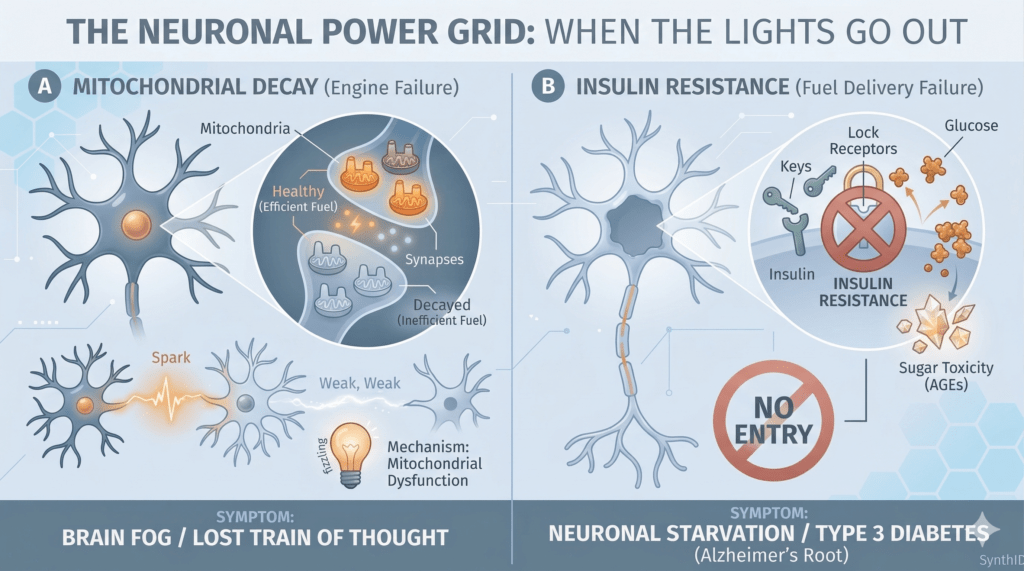
The brain is your body’s most expensive organ to run. Though it’s only 2% of your weight, it devours 20% of your total energy. To think, learn, and remember, your “internal lights” require a massive, uninterrupted flow of electricity. This power grid fails in two distinct ways:
- Mitochondrial Decay (The Engine Failure): Inside every neuron are tiny power plants called mitochondria. They create the “spark” that allows brain cells to talk to each other. When these mitochondria decay, the voltage drops. Your neurons stay alive, but they go effectively mute. This “power flickering” is why the first signs of decline are often brain fog or losing your train of thought.
- Deep Dive: 2 Guides on Mitochondrial Health and how to restart your cellular engines
- Insulin Resistance (The Fuel Blockade): Even a perfect power plant needs fuel. Insulin is the “key” that unlocks your brain cells to let energy (glucose) in. When we overstress the system with too much sugar, the cells become resistant to insulin and the locks stay shut. This creates a lethal paradox: your brain is awash in fuel, yet your neurons are starving. This total fuel failure—starvation amidst plenty—is why scientists increasingly call Alzheimer’s “Type 3 Diabetes.”
Growth & Connection (The Wiring)
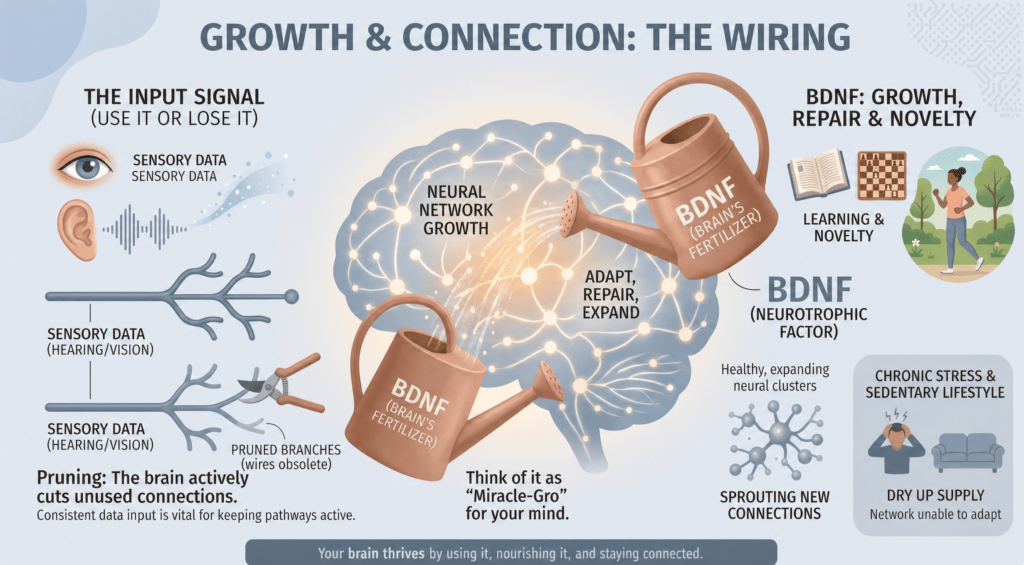
Your brain is not a static organ; it is a living “use it or lose it” network that must maintain old connections and sprout new ones.
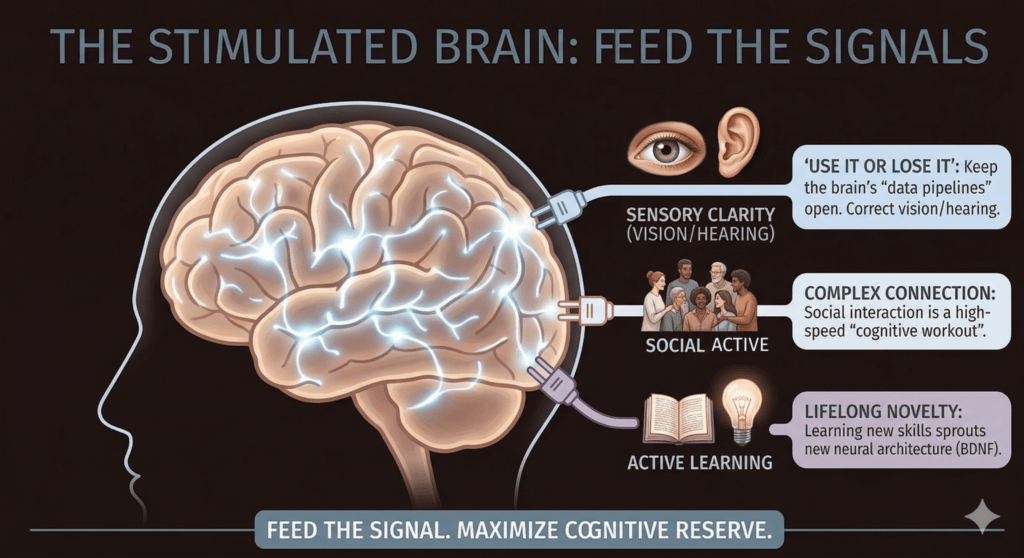
- The Input Signal: Your brain thrives on data. When sensory signals—like hearing or vision—decline, the brain assumes those “wires” are obsolete and actively prunes them. Without consistent input, these vital pathways simply wither away.
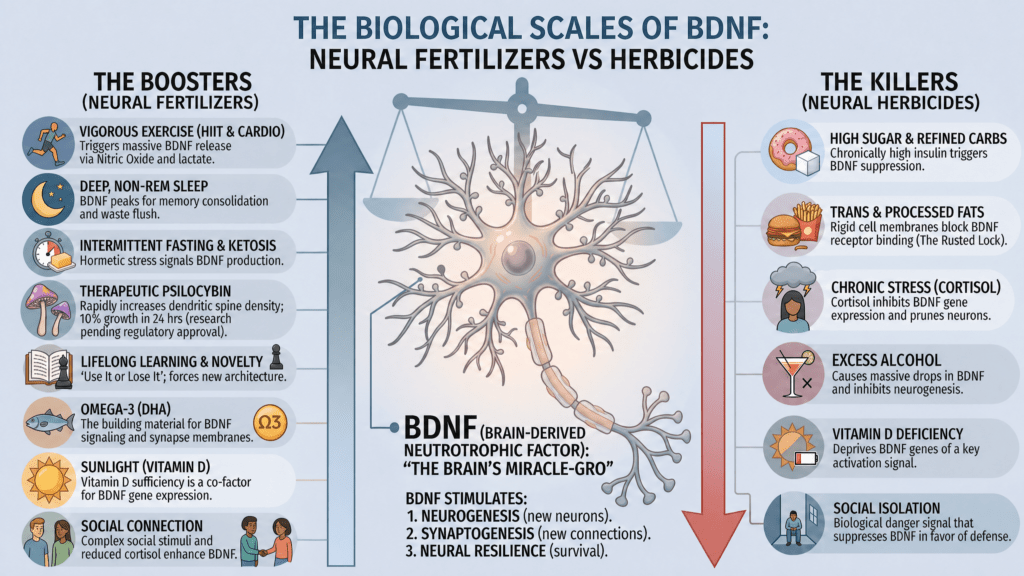
- BDNF (The Brain’s Fertilizer): To repair and grow, your neurons require a protein called BDNF. Think of it as “Miracle-Gro” for your mind. Chronic stress and a sedentary lifestyle dry up this supply, leaving your neural network unable to adapt, repair, or expand.
Waste Management: Clearing the Trash
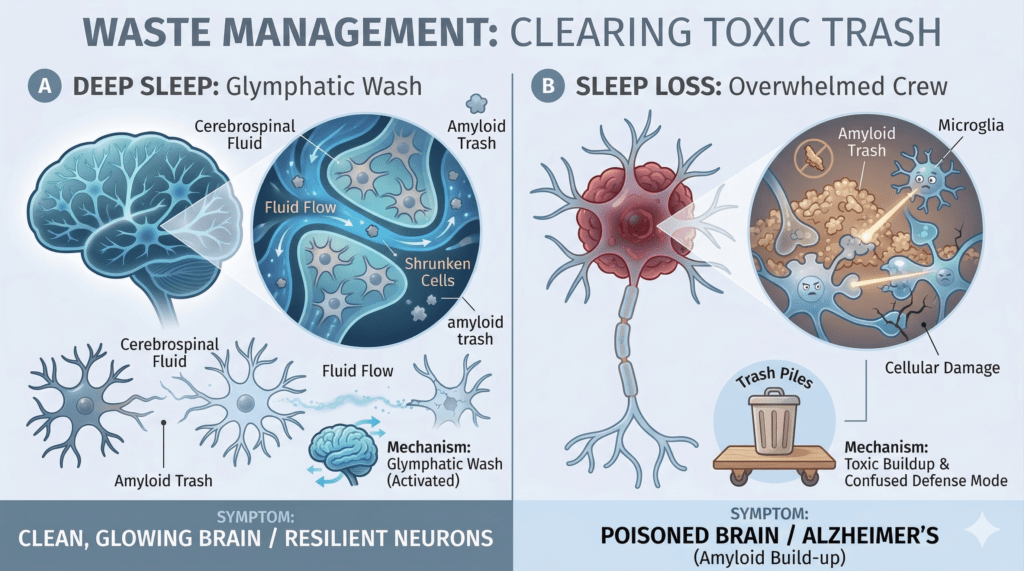
Every living system creates metabolic waste. In the brain, this waste includes toxic proteins like amyloid—the hallmark of Alzheimer’s.
- The Glymphatic System: The brain’s clearance pathway is primarily active during deep, non-REM sleep. During this phase, the space between nerve cells increases by approximately 60%, opening the channels for fluid to flush away the day’s metabolic waste.
- Immune Dysregulation: Chronic inflammation or sleep deprivation disrupts this clearance. In response, the brain’s resident immune cells (microglia) shift from a “restorative” state to a “pro-inflammatory” state. Instead of clearing amyloid, they release cytokines that damage healthy neurons while toxic proteins continue to aggregate.
The Bottom Line: Without adequate deep sleep, the brain cannot execute its essential metabolic cleanup, leading to protein toxicity and cellular decay.
The 7 Core Habits: Reboot The System
If dementia is a “systems failure,” the solution is a systems upgrade. You don’t need a miracle drug; you need to change the inputs.
1. Eat Clean (Fuel the Power Grid)
- The Action: Build every meal around this “Trinity of Whole Foods”: Complete Protein, Healthy Fats, and Whole-Plant Fiber (both soluble and insoluble).
- The Why: This “food architecture” prevents the insulin spikes that rust your cellular locks. The antioxidants found only in whole plants—not supplements—act as a coolant, neutralizing the toxic “smoke” that otherwise damages your mitochondria.
Go Deeper: Download my free Eat Clean Guide
2. Move Strong (Grow the Wiring)
- The Action: Prioritize both Resistance Training (strength) and Aerobic Movement (stamina).
- The Why: Exercise is a biological signal for growth. It triggers the release of BDNF, the “Miracle-Gro” that helps neurons repair and sprout new connections. Simultaneously, it produces Nitric Oxide, which widens the brain’s “pipes” to force-feed oxygen and nutrients deep into the tissue.
Go Deeper: Read my guide on Nitric Oxide
3. Heal Your Gut (Silence the Fire)
- The Action: Feed your microbiome a wide range of whole-plant fibers to increase diversity. Aim for a variety of 30 different plants per week.
- The Why: The gut and brain are joined by a biological superhighway: the vagus nerve. Because 70–80% of your immune system is located in the gut lining (GALT), your microbiome acts as the master control switch for systemic inflammation.
Go Deeper: 15 ways to feed your microbiome and silence the fire
4. Mindset Matters (Shield and Stimulate)
- The Action: Protect your brain from internal stress with daily breathwork and strengthen it through external engagement—including correcting vision/hearing and staying socially active.
- The Why: Chronic stress floods the system with cortisol, which physically shrinks the hippocampus (your memory center). Simultaneously, your brain follows a strict “use it or lose it” principle; if sensory or social input stops, the brain prunes those pathways to save energy.
Go Deeper: Transform your mindset,: A simple Guide to Lasting Change
5. Rewild (Nature as Medicine)
- The Action: Spend at least 20 minutes in nature daily and prioritize morning sunlight exposure.
- The Why: Natural light is the primary driver of your circadian rhythm, signaling your brain to produce melatonin 12–14 hours later. Simultaneously, forest compounds called phytoncides activate the vagus nerve, flipping your system from “fight or flight” into “repair” mode.
Go Deeper: The Science of Rewilding
6. Connect (The Social Safety Net)
- The Action: Prioritize consistent, face-to-face social interaction and complex collaborative tasks.
- The Why: Isolation is a biological signal of danger that keeps the brain in a state of high inflammation. Complex conversation acts as a high-speed cognitive workout that stimulates the vagus nerve, signaling the brain to shift resources from “defense” to “repair.”
Go Deeper: The Longevity Link: Why social connection is the key to longevity
7. Sync to Restore (Metabolic Clearance)
- The Action: Prioritize 7–9 hours of consistent sleep and eliminate alcohol, which disrupts the architecture of deep, non-REM sleep.
- The Why: Deep sleep is the brain’s primary window for metabolic clearance. During this phase, the expansion of interstitial space allows cerebrospinal fluid to flush away neurotoxic proteins like amyloid. Alcohol acts as a biological “glitch,” blocking these deep stages.
Go Deeper: Read the guide on The Science of Sleep
The Big Picture: You Are The CEO Of Your Biology
Dementia is often the logical end-point of a system that has been over-stressed, under-fueled, and left with the “trash” uncollected for too long. But because your brain is part of a dynamic, living system, you have the power to change its trajectory.
It is often said that genetics may load the gun, but lifestyle pulls the trigger. While genetics provide the initial blueprint, the 2024 Lancet Commission identifies that at least 45% of dementia cases are driven by modifiable lifestyle factors. However, many metabolic researchers argue this is a conservative floor. When you account for “root causes” like brain-specific insulin resistance (Type 3 Diabetes) and mitochondrial decay, emerging data suggests that upwards of 65-70% of cognitive decline may be preventable. This means that for the vast majority of us, our brain health is not a matter of fate; it is a matter of maintenance. Just because a disease “runs in the family” doesn’t mean it is purely genetic—often, it is the shared habits and environments that are being passed down.
When you choose clean fuel, nurture your mitochondria, and clear out the waste, you aren’t just reducing your risk of disease—you are upgrading your entire human experience. Your brain simply reflects the health of the system that supports it.
Which habit do you want to work on today? Don’t try to over-engineer the whole system at once. Start with the one that is speaking to you.
Scientific Foundations
- The 45%–65% Modifiable Risk Factor: Livingston, G., et al. (2024). “Dementia prevention, intervention, and care: 2024 report of the Lancet Commission.” The Lancet.
- The ReCODE Protocol (74% Success): Bredesen, D. E., et al. (2022). “ReCODE: A Personalized, Targeted, Multi-Factorial Therapeutic Program for Reversal of Cognitive Decline.” Biomedicines.
- The “Type 3 Diabetes” Connection: de la Monte, S. M., & Wands, J. R. (2025). “The role of central insulin resistance in the pathogenesis of Alzheimer’s disease: Type 3 Diabetes revisited.” Nature Reviews Endocrinology.
- Mitochondrial Decay and Bioenergetics: Swerdlow, R. H. (2024). “The mitochondrial cascade hypothesis: Bioenergetics as the primary driver of neurodegeneration.” Cell Metabolism.
- Glymphatic Clearance and Deep Sleep: Hablitz, L. M., & Nedergaard, M. (2025). “Glymphatic system in neurological disorders and implications for brain health.” Frontiers in Neurology.
- Exercise and BDNF (Miracle-Gro): Wang, S., et al. (2024). “Effects of aerobic exercise on cognitive function and BDNF levels: A systematic review.” Journal of Alzheimer’s Disease.
- The Gut-Brain Vagus Connection: Thaiss, C., et al. (2026). “Enhancing gut-brain communication reverses cognitive decline.” Nature Communications.
- Nitric Oxide and Vascular Health: Iadecola, C., et al. (2025). “Nitric Oxide and the neurovascular unit: Maintenance of the brain’s plumbing.” JCI Insight.
- Whole Food Matrix vs. Supplements: “Antioxidant Supplements: What You Need To Know.” National Institutes of Health (NIH) Clinical Digest, 2024/2025 Update.
- Nature and Vagal Tone: Hunter, M. R., et al. (2019/Updated 2024). “Urban Nature Experiences Reduce Cortisol.” Frontiers in Psychology.